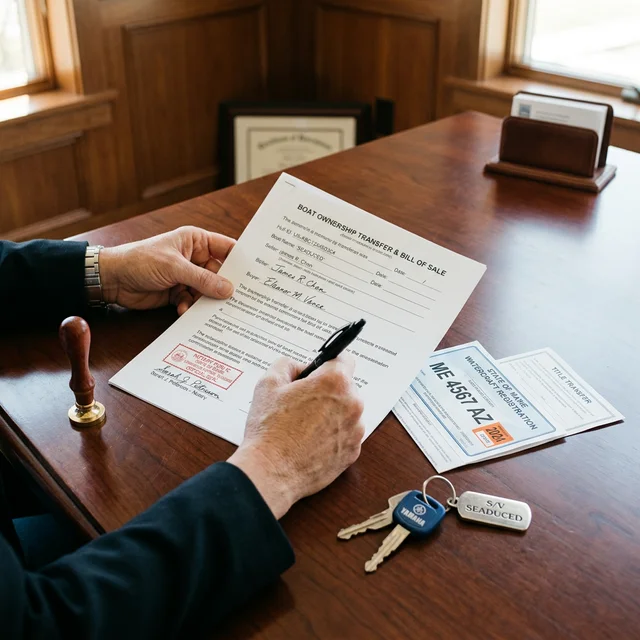
Boat Title Transfer Direct Answer
What should the buyer get?
Get the seller-signed title where titles are required, a detailed bill of sale, current registration, HIN match, and lien release if a loan ever existed. If the seller name does not match, pause before filing.
Who fixes it before sale?
In a title state, the seller should resolve a lost or missing title before closing. A duplicate or bonded-title path may be possible, but do not treat a verbal promise as clear ownership.
When is it required?
If the boat was financed, require written lien-release proof before filing the transfer or paying in full. A lien can block clear title even after the boat changes hands.
Can transfer and registration happen together?
Often yes. Many states process title transfer, sales or use tax, and new registration in the same visit or packet, but the exact path is state-specific.
State Page vs Title Transfer Guide
Go to a state registration page when you need current title requirements, fees, agency links, renewal timing, or state-specific filing steps.
Stay here when the problem is buyer and seller paperwork, signed title handling, lien releases, HIN checks, bill of sale records, or missing-title risk before filing.
Step-by-Step Title Transfer Process
The title transfer process follows these key steps in states that require boat titles:
Seller Signs the Title
The seller must sign the title on the designated assignment section. This includes the date of sale, purchase price, seller's signature, and printed name. Both buyer and seller should complete their respective sections.
Obtain a Lien Release (If Applicable)
If the boat has an outstanding loan, the seller must pay it off and obtain a lien release from the lender. This document must be submitted with the title transfer application.
Complete the Title Application
The buyer fills out the state's title application form. This typically requires the vessel description, HIN, purchase price, and buyer's personal information.
Pay Fees and Sales Tax
Submit the signed title, application form, and payment for the title transfer fee and applicable sales/use tax to the state agency.
Receive New Title and Registration
The state issues a new title in the buyer's name. In most states, you can simultaneously apply for new registration at the time of title transfer.
Required Documents
Seller Must Provide
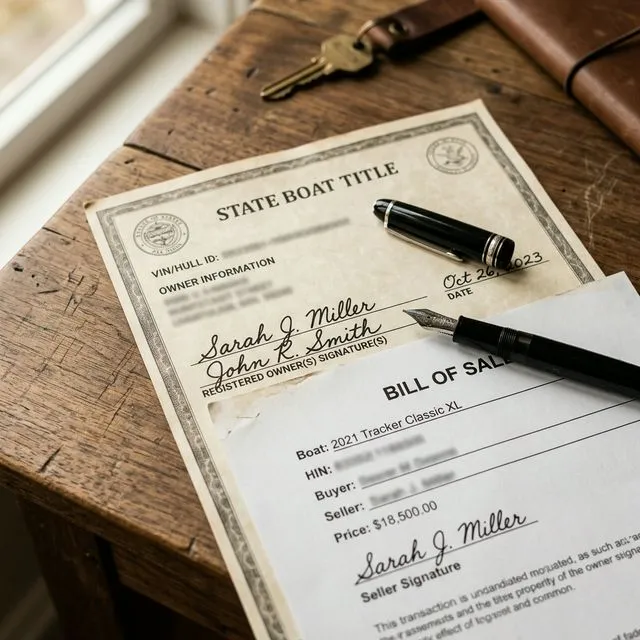
- Signed title (on the assignment section)
- Bill of sale with purchase price and date
- Lien release (if the boat was financed)
- Current registration certificate
- Photo ID
Buyer Must Provide
- Completed title application form
- Photo ID
- Payment for title fee, registration, and sales tax
- Proof of insurance (required in some states)
- Lien information (if financing the purchase)
Title Transfer Fees by State
Title fees vary by state and by vessel. This table lists agency fee examples; states that need current agency confirmation are listed separately instead of showing exact title fees.
| State | Title Fee | Sales Tax Rate | Sales Tax Cap |
|---|---|---|---|
| Alabama | $25.00 | Confirm by transaction | Confirm |
| Arkansas | $0.00 | 6.5% state starting point | No cap |
| California | $0.00 | 7.25% | No cap |
| Connecticut | $25.00 | 2.99% vessel rate | No cap |
| Florida | $5.25 | 6% (max $18,000 tax) | $18,000 |
| Georgia | $0.00 | Confirm by transaction | Confirm |
| Hawaii | $20.00 | No sales tax; confirm GET/use tax | Confirm |
| Illinois | $0.00 | Tax proof varies | No cap |
| Indiana | $15.00 | 7% | No cap |
| Iowa | $13.50 | 6% + local | No cap |
| Kentucky | $9.00 | 6% + county items | No cap |
| Maryland | $20.00 | 5% (max $16,100) | $16,100 |
| Massachusetts | $27.50 | 6.25% | No cap |
| Michigan | $5.00 | 6% | No cap |
| Minnesota | $22.00 | 6.875% | No cap |
| Missouri | $7.50 | 4.225% | No cap |
| Montana | $10.00 | None | No cap |
| Nebraska | $10.00 | 5.5% | No cap |
| Nevada | $20.00 | Confirm by sale type | Confirm |
| New Jersey | $60.00 | 6.625% | No cap |
| New Mexico | $10.00 | 5% excise tax | Confirm |
| New York | $50.00 | Confirm by county/form | Confirm |
| North Carolina | $36.00 | 3% (cap $1,500) | $1,500 |
| Ohio | $15.00 | State + local | Confirm |
| Oklahoma | $2.25 | Excise tax varies | No cap |
| Oregon | $75.00 | No general sales tax | No cap |
| Pennsylvania | $30.00 | 6% | No cap |
| Rhode Island | $25.00 | No boat sales tax; motor caveat | No cap |
| South Carolina | $20.00 | 5% (cap $500) | $500 |
| South Dakota | $10.00 | 3% large-boat excise | Confirm |
| Texas | $27.00 | 6.25% (cap $18,750) | $18,750 |
| Vermont | $27.00 | Confirm 6% basis | No cap |
| Virginia | $10.00 | 2% (max $2,000) | $2,000 |
| Washington | $5.00 | 6.5% | No cap |
| West Virginia | $15.00 | 6% | No cap |
| Wisconsin | $5.00 | 5% + local | No cap |
| Wyoming | $15.00 | 4% | No cap |
States With Conditional Title Rules
These states have title rules that depend on the exact boat, motor, financing, prior-title, HIN, or documentation facts. Use the state page before treating a title fee as part of every transfer.
| State | When to Check | Title Item | Transfer Item |
|---|---|---|---|
| Alaska | Undocumented boats longer than 24 feet must be titled unless a No Title Issued registration applies. Boats 24 feet or less may be titled voluntarily, and USCG documented boats are registered but not titled by Alaska. | $20 when title applies | Confirm by vessel |
| Idaho | Idaho boat titling is conditional. ITD says title rules can apply to model-year 2000 or newer vessels with permanently attached propulsion, model-year 2000 or newer non-exempt vessels over 12 feet, and financed vessels. | Confirm by vessel | Confirm by vessel |
| Louisiana | A boat or outboard motor must be titled when it is financed, currently titled in Louisiana or another state, homemade, or has an incorrect Hull Identification Number. LDWF lists Louisiana as an optional titling state for other boats and motors. | $26 when title applies | $5 transfer; title separate |
States That Don't Require Titles
These 7 states do not require a standard boat title. In these states, ownership is usually established through registration, a bill of sale, and accepted ownership documents:
States Needing Title Confirmation
Confirm these states directly with the agency before relying on exact title requirements, title fees, transfer fees, or no-title status.
Special Transfer Situations

Gifting a Boat
When gifting a boat, the ownership record usually still needs to be updated. Some states offer tax exemptions or different forms for family gifts, but the accepted relationship, form, and tax treatment vary. You may need to:
- Complete a gift affidavit or declaration
- Submit the signed title with the gift notation
- Pay the title transfer fee (though sales tax may be waived)
Inherited Boats
Transferring a title for an inherited boat typically requires:
- Certified copy of the death certificate
- Letters testamentary or letters of administration from the probate court
- The original title (or duplicate title application)
- New title application in the heir's name
Abandoned or Bonded Titles
If you've acquired a boat without a proper title, some states offer a bonded title, registration-only, assigned-HIN, or ownership-review process:
- You purchase a surety bond for the vessel's value
- The state may issue a bonded or restricted title that clears only after a state-defined waiting period
- Not all states offer this option — check your state's specific process
For deeper paperwork help, see the gifted or inherited boat transfer guide,missing boat title guide, andHIN inspection guide.
Title Transfer Checklist
Frequently Asked Questions
What is a boat title transfer?
A boat title transfer is the legal process of changing ownership of a vessel from one person (or entity) to another. It involves the seller signing the title over to the buyer and the buyer filing the transfer with the state titling agency.
How much does a title transfer cost?
Title and transfer costs vary by state and by vessel. Check the state row for agency fee examples, then confirm title, transfer, registration, lien, and tax items before paying.
Can I transfer a title without the original?
In a title state, the seller usually needs to resolve a lost title through the state duplicate, bonded-title, registration-only, or agency-approved ownership-proof path before the buyer can file cleanly.
How long does a title transfer take?
Processing time depends on the state, filing method, document quality, liens, taxes, and whether the boat also needs registration. Confirm timing with the agency before planning to operate or resell.
Do I need a title transfer for a gift or inheritance?
Often yes, but the paperwork can differ from a normal sale. Gifts may need a gift statement or tax form, and inherited boats may need executor, heir, probate, small-estate, or death-certificate documents.
What if there's a lien on the boat?
Do not close or release final funds until the payoff and lien-release path is clear. The state may need lender release proof before it will issue, transfer, or clear a title record.
What if the seller name does not match the title or registration?
Pause the transaction and trace the ownership chain. A mismatched seller name can mean a missing assignment, estate transfer, dealer reassignment, lienholder issue, or skipped title step.
Can I operate while the transfer is pending?
Some states recognize a temporary permit, application receipt, or dated bill of sale for a limited period, while others do not. Use the state page or temporary permit guide before operating.
Does the trailer or outboard motor need separate paperwork?
Often yes. Boat, trailer, and outboard motor records can be handled by different agencies or forms, so confirm trailer title/registration and motor-title rules separately.