
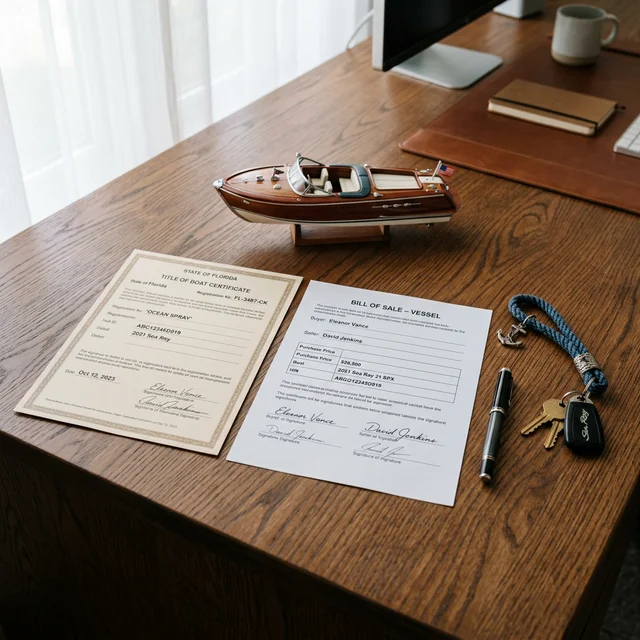
Title vs Registration Direct Answer
A boat title proves ownership. Boat registration, often called a certificate of number, gives permission to operate the vessel on public waterways and display state numbers or decals. Depending on the state and vessel, you may need a title, active registration, both, or supporting ownership documents such as a bill of sale and prior registration.
For state-specific filing rules, open the state directory. For ownership-change problems, use the title transfer guide, bill of sale guide, and missing title guide.
State Page vs This Guide
Use the state page when you need to know whether that state requires a boat title, what the fee is, and which agency handles registration.
Use this guide when the question is conceptual: title vs registration, ownership proof vs operating permission, and how no-title states handle paperwork.
The Key Differences
Boat titles and registrations are two distinct legal documents that serve different purposes:
| Feature | Title | Registration |
|---|---|---|
| Purpose | Establishes legal ownership | Grants right to operate on public waters |
| Analogy | Like a deed to a house | Like a license plate and registration card for your boat |
| Required in | Some states and vessel classes | Broadly required for powered public-water use, with state exceptions |
| Renewal | One-time (transfers with sale) | Periodic (annual, biennial, or triennial) |
| Main Function | Proves who owns the vessel | Assigns a registration number for identification |
| Lien Recording | Can record liens against the vessel | Usually does not record liens |
What Is a Boat Title?
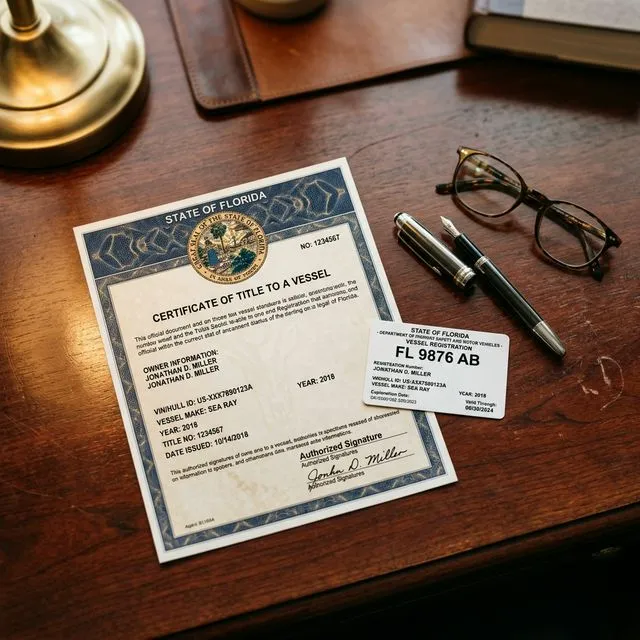
A boat title is an official government document that establishes legal ownership of a vessel. It commonly contains:
- Owner's name and address
- Vessel description (make, model, year, length)
- Hull Identification Number (HIN)
- Lien information, if a loan is recorded
- Issue, transfer, or prior-title information where the state includes it
Why Titles Matter
Titles serve several important purposes:
- Proves ownership — Important when selling or transferring the boat
- Reduces theft risk — Makes it harder to pass off a stolen vessel as clear property
- Records liens — Protects lenders by recording their financial interest
- Supports chain of ownership — Helps the agency connect the current owner to prior ownership documents
What Is Boat Registration?
Boat registration is the process of recording your vessel with your state agency and obtaining a registration number and validation decals. This grants you the legal right to operate on public waterways when your vessel falls under state numbering rules.
Registration Provides
- A unique registration number (e.g., FL 1234 AB) displayed on your hull
- Validation stickers/decals proving current registration
- Legal authorization to operate on public waters
- A way for law enforcement to identify your vessel
- Safety — registered vessels can be traced if found adrift or involved in incidents
Registration Is Broadly Required for Powered Boats
Most states require registration or a certificate of number before a motorized, propulsion-equipped, or otherwise covered vessel operates on public waters. Exact exemptions, visiting-vessel reciprocity, documented-vessel treatment, private-water use, and non-motorized thresholds vary by state.
States That Require Titles
Whether your state requires a boat title depends on your location, vessel type, length, model year, documentation status, and whether a lien is recorded. Many US states require titles for covered boats, but the trigger is rarely as simple as every vessel in every situation.
Title-rule examples to check
Use these examples to understand the kinds of title rules states apply, then confirm the current agency requirement before filing:
- Florida — FLHSMV vessel title and registration rules apply, with statutory exemptions and county tax collector filing paths.
- Texas — TPWD title and registration rules vary by motorboat, sailboat, outboard motor, and exempt-vessel category.
- Ohio — Watercraft title work goes through county Clerk of Courts title offices, while registration questions are handled separately.
- Connecticut — Title rules depend on vessel type, length, and model year, while registration rules use a broader public-water operation screen.
- Hawaii — Undocumented vessel title and registration rules are handled through DOBOR.
- Arkansas — Motorboat title rules now apply; confirm model-year and transfer paperwork with DFA.
- Vermont and Idaho — Conditional title rules apply, so do not rely on an old no-title summary without opening the state agency path.
States That Do Not Issue Boat Titles in Many Routine Cases
Some states use registration and ownership documents instead of a separate boat title for many recreational transactions. Examples to check include:
- Delaware — Registration and ownership-document handling through DNREC
- Kansas — Registration-centered ownership proof through KDWP
- Maine — Registration and municipal excise-tax paperwork rather than a boat title
- North Dakota — Registration-centered watercraft records
- Tennessee — Registration and county-clerk sales-tax certification, not a separate boat title
When You Need Both
In states that require titles for your vessel class, you often need both a title and a registration. They serve complementary purposes:
- Title — Proves you are the legal owner
- Registration — Gives you permission to operate on public waters
The typical process is:
- Obtain the title or acceptable ownership document through purchase, transfer, inheritance, or manufacturer's certificate of origin
- Apply for registration using the ownership document the state accepts
- The state issues the title and registration together or routes them through separate title and registration offices
Special Cases
- USCG documented vessels: Federally documented boats follow federal documentation and marking rules. A state may still require tax handling, decals, use stickers, or registration-related paperwork, but state bow-number rules can differ.
- Out-of-state purchases: If buying from a title state and moving to a non-title or conditional-title state, keep the selling-state title or ownership chain until the receiving agency tells you what it will accept.
Protecting Yourself as a Buyer
Whether your state requires a title or not, take these steps to protect yourself when purchasing a boat:
In Title States
- Review the signed title and agency transfer instructions before paying
- Check for recorded liens through the title or registration agency
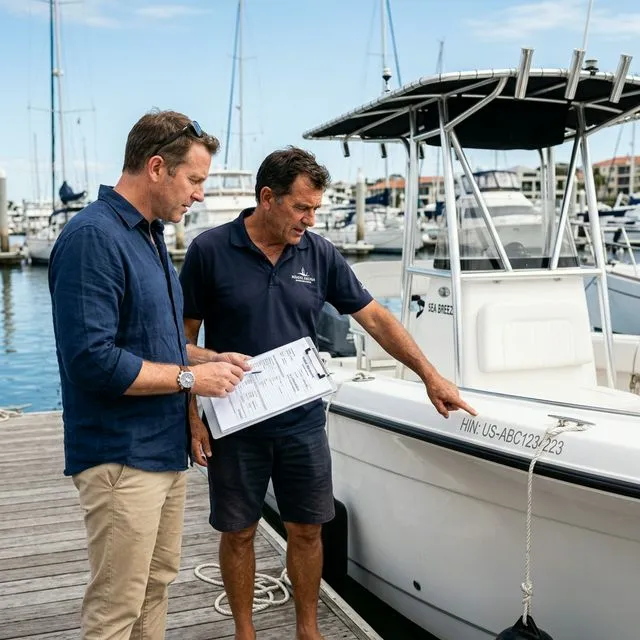
- Confirm the HIN on the boat matches the title
- Ensure the seller's name matches the title or has agency-accepted authority to sell
In Non-Title States
- Get a detailed, written bill of sale with both parties' full information
- Obtain the previous registration certificate
- Ask for any chain of ownership documentation
- Verify the HIN against the registration
- Consider a UCC or agency record search when a lender or unclear ownership history is possible
If title status is still the blocker, use the title requirements checker first. For a buyer paperwork sequence, see: How to Register a Used Boat.
Frequently Asked Questions
Is a boat title the same as a boat registration?
No. A title proves ownership (like a house deed), while a registration grants permission to operate on public water (like a driver's license). They serve different purposes.
Do I need a title if my state doesn't require one?
If the state does not issue a title for your vessel, you usually rely on ownership documents such as a bill of sale, prior registration, HIN proof, tax forms, or an out-of-state title if one exists. Keep the full paper trail because a future buyer or title state may ask for it.
Can I sell a boat without a title?
Sometimes. In a non-title or non-titleable situation, the state may accept a bill of sale, prior registration, and supporting ownership documents. In a title state, get the title corrected, transferred, or duplicated before closing unless the agency gives a different written path.
What does a boat title cost?
Title fees vary by state and transaction. Check the state agency page for the current title, duplicate title, lien, transfer, tax, and service-fee amounts before relying on a final total.
Does a boat title expire?
No, boat titles do not expire. They remain valid until the vessel is sold, transferred, or destroyed. Registrations, however, must be renewed periodically.