
When Out-of-State Registration Applies
Direct answer: register and title the boat in the state that requires it before you operate there or within that state's allowed filing period. Moving, buying out of state, seasonal storage, and visitor use are different situations; trailering through without launching is usually separate from vessel registration.
Out-of-state boat registration situations typically fall into four categories:
- Permanent relocation: You're moving to a new state and bringing your boat with you
- Out-of-state purchase: You bought a boat in another state and need to register it in your home state
- Seasonal use: You keep a boat in a state where you have a vacation property
- Transit only: You trailer through a state without launching the boat
Each scenario can have different state-specific deadlines, title rules, decal requirements, and tax paperwork.
Relocating Your Boat to a New State
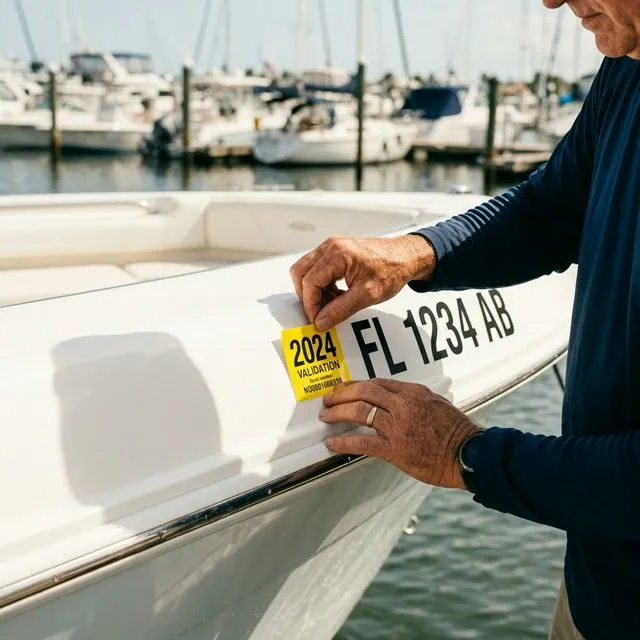
When you permanently move your boat to a new state, follow these steps:
- Research the new state's requirements — Check fees, title requirements, and whether a physical HIN inspection is needed
- Gather your documents: Current title (if applicable), registration, bill of sale, and lien release
- Apply within the new state's filing period — Some states use 30 days, 60 days, 90 days, principal-use tests, or transaction-specific deadlines
- Transfer the title — In title states, apply for a new state title using your out-of-state title
- Handle applicable tax proof — Bring purchase receipts and any proof of tax already paid; credits and exemptions vary by state
- Notify the prior state if required — Some agencies ask you to cancel, surrender, or update records after the boat leaves
- Display new registration numbers — Remove old decals and display the new state's numbers
Sales and Use Tax Considerations
Sales tax, use tax, or vessel excise tax can be one of the largest costs when registering an out-of-state boat. Treat prior tax payments as documents to prove, not as an automatic credit.
| Scenario | Tax Obligation |
|---|---|
| Paid full sales tax in purchase state | Possible credit or exemption if the new state allows it and you can prove the prior tax payment |
| No sales tax in purchase state | New state may require use tax, vessel excise tax, or proof that no tax is due |
| Purchased in a no-sales-tax state (e.g., Delaware) | New state may calculate tax from purchase price, fair market value, or state-specific valuation rules |
| Owned for 6-12+ months before moving | Some states have prior-use exemptions or credits; others still require proof or filing review |
Title Transfer for Out-of-State Boats
Transferring a title between states requires additional steps:
- Title state → Title state: Submit your current state title to the new state's titling agency. They'll issue a new title in their format.
- Title state → Non-title or conditional-title state: Your old state title may be accepted as proof of ownership, or the agency may ask for the title plus a bill of sale, HIN proof, or tax form.
- Non-title state → Title state: You'll usually need the prior registration, bill of sale, and any chain-of-ownership documents to obtain a title in the new state.
Seasonal/Dual-State Boating

If you split your time between two states with a boat:
- Confirm which state treats the boat as principally used, operated, docked, or stowed there
- Use the visitor or non-resident rules only while you remain within that state's temporary-use allowance
- If you exceed the allowance, the other state may require local registration, decals, taxes, or permits
- Do not display two active bow-number sets unless an agency specifically instructs you to do so
Find Your State's Requirements
Frequently Asked Questions
Do I need to re-register my boat when I move to a new state?
Usually yes. When the boat becomes principally used or kept in the new state, that state can require local registration, title review, decals, tax paperwork, or permits. Deadlines vary, so check the new state before operating.
Can I keep my old state registration number?
No. Each state assigns its own unique registration number prefix. You must display the new state's registration number and remove the old one.
Do I owe sales tax if I bought the boat in another state?
Possibly. Many states impose sales tax, use tax, vessel excise tax, or proof-of-tax requirements when a boat is brought in from another state. Credits for tax already paid are common in some states, but they depend on proof and local rules.
What about USCG documented vessels?
USCG documented vessels follow federal documentation and marking rules, but state decals, taxes, use stickers, permits, or registration-related paperwork may still apply where the vessel is principally used.
Can I trailer my boat through a state without registering?
Trailering through without launching usually does not create a vessel registration duty. Trailer registration, invasive-species checks, inspection stops, or launch permits can still apply.