
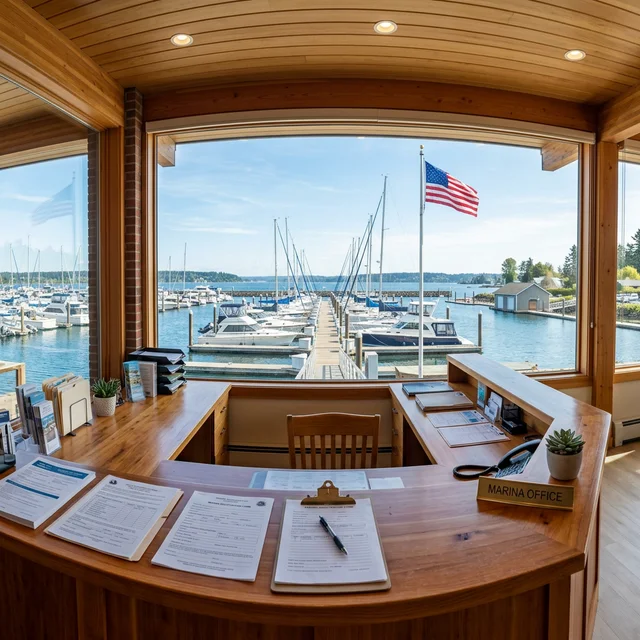
How Do You Register a Boat?
Register the boat with the state where it will be principally used or kept. Gather ownership proof, HIN details, buyer ID, tax documents, and any title or lien paperwork; submit the state application; pay required fees; then display the assigned numbers and decals after the state issues them.
- Choose the state and agency using the state guide directory.
- Gather ownership and HIN records, including the title or prior registration when applicable.
- Check title, tax, and fee items before submitting the application.
- File and pay through the agency path that fits the transaction.
- Display the issued number and decals and track the state renewal date.
Most states require registration for motorized boats before they operate on public water. Non-motorized boats, sailboats, documented vessels, tenders, private-water vessels, and trailers are handled differently by state, so confirm the current rule on the relevant state guide before relying on an exemption.
Vessels That Often Require Registration
- Motorboats, including boats with electric trolling motors in many states
- Personal watercraft such as jet skis and WaveRunners
- Sailboats with auxiliary motors
- Some sailboats or non-motorized boats above a state length threshold
- Houseboats or other vessels used on public waterways
Common Exemption Questions
- Non-motorized canoes, kayaks, and paddleboards may be exempt in many states, but not everywhere
- USCG documented vessels use a federal documentation record, but state decals, taxes, or registration-related duties may still apply
- Private ponds, government-owned vessels, racing craft, lifeboats, and tenders depend on state wording
Required Documents
Specific requirements vary by state and transaction type. New boats, used boats, no-title boats, liened boats, documented vessels, trailers, tax filings, and temporary-operation questions can each require different proof.
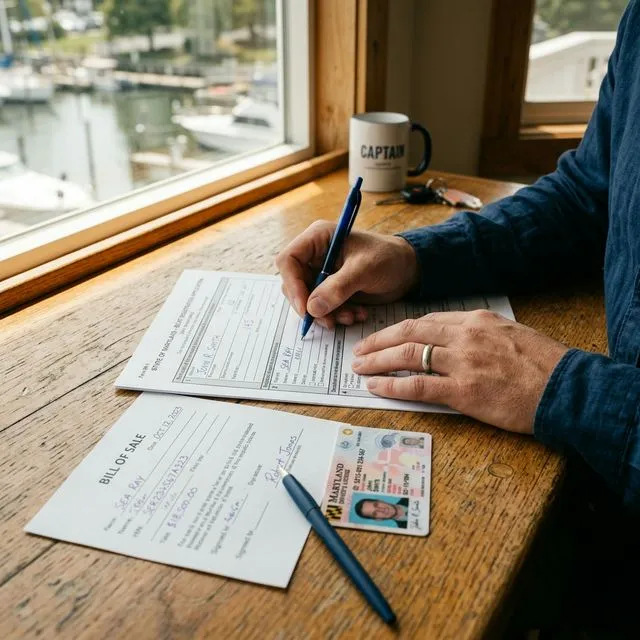
For New Boat Purchases
- Manufacturer's Certificate of Origin (MCO) - Often provided by the dealer for a new boat
- Bill of sale or purchase agreement - Showing purchase price, date, buyer, seller, and included items
- Photo ID - Valid driver's license or state-issued identification
- Sales tax documentation - Dealer receipt, state tax form, or agency-required proof
- Hull Identification Number (HIN) - The boat identifier used on the application and ownership record
For Used Boat Purchases
- Signed title from the seller - If the state titles that boat
- Previous registration certificate - Especially important for non-title states or out-of-state records
- Bill of sale - With actual purchase price and date
- Lien release - If a lender appears on the title or record
- Sales or use tax documents - See the boat sales tax guide for state context
Step-by-Step Registration Process
Step 1: Determine Your State's Requirements
Start with the state where the boat will be principally used or kept. Use the state guides to find the agency, deadline, online path, title rule, and fee context for your state.
Step 2: Gather Required Documents
Collect the ownership, HIN, ID, tax, title, lien, and application documents listed above. For a private purchase, use the used boat registration guide before filing.
Step 3: Choose Your Registration Method
Registration methods vary by state and transaction type:
- Online: Often available for renewals or simple records; first registration and title transfer may still require original documents.
- In person: Useful for new boats, transfers, out-of-state paperwork, missing title, lien, or HIN questions.
- By mail: Available in some states when forms, original documents, and payment can be submitted together.

Step 4: Pay the Required Fees and Taxes
Base registration fees, title fees, sales/use tax, aquatic invasive species items, county charges, and online service fees are separate. Use the state-by-state cost guide for context, then verify the total with the agency handling your file.
Step 5: Display Your Registration Number
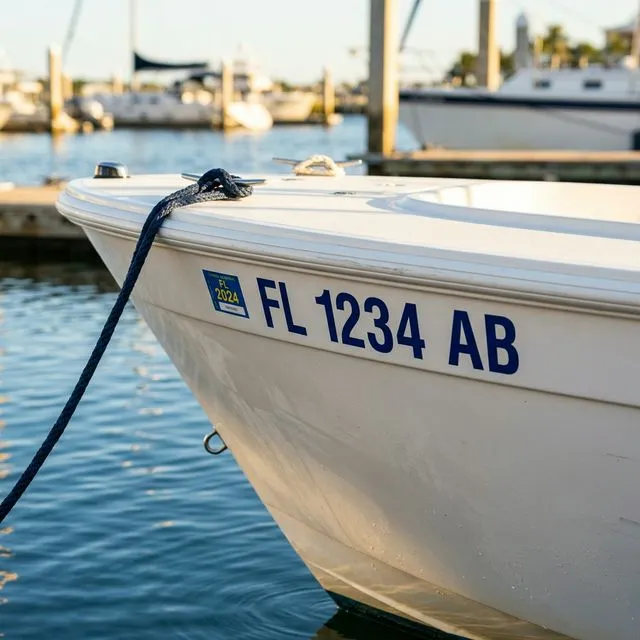
After registration, display your assigned number and decals according to state rules. Many states follow the familiar bow-number pattern:
- Block letters and numbers at least 3 inches tall
- Contrasting color against the hull
- Read from left to right on both sides of the forward half of the vessel
- Spaces or hyphens between letter and number groups where required
Online vs. In-Person Registration
Online boat registration is useful when the state offers it for your transaction, but it is not a universal first-registration path. Renewals and simple owner records are more likely to be eligible than new purchases, title transfers, lien releases, missing-title files, or out-of-state paperwork.
| Feature | Online Registration | In-Person or Mail Filing |
|---|---|---|
| Best fit | Renewals, duplicate decals, or simple records where the state allows it | New boats, used-boat transfers, missing title, lien, HIN, or original-document files |
| Documents | Uploads or existing state records where accepted | Original title, MCO, lien release, notarized form, or agency inspection where required |
| Timing | May issue confirmation, receipt, or temporary authority | Processing depends on the office, mail time, and whether documents are complete |
| Payment | Usually card or electronic payment | Card, check, cash, or agency-specific payment method |
Understanding Registration Fees
Boat registration fees vary widely across the United States. Treat the base registration fee, title fee, tax, local fee, and service fee as separate parts of the total cost.
Base Registration Fee
Many states calculate registration fees by vessel length, propulsion, use, or registration period. Others use flat fees or special classes for PWC, documented vessels, nonresidents, or commercial use.
Additional Costs to Consider
- Title fee: Required when the state titles your boat or processes an ownership transfer
- Sales/use tax: Transaction-specific tax may apply to the purchase price or value, with state rules for private sales and out-of-state purchases
- Aquatic invasive species fees: Some states add prevention stickers, stamps, or surcharges
- Nonresident or local items: County, waterway, nonresident, agent, or online fees may apply
For state-by-state context, visit the boat registration cost guide. Confirm the final amount with the agency before payment.
Do You Need a Title?
Not all states require a boat title, and some states title only certain boats by length, model year, engine type, lien status, or use. A title is ownership evidence; registration is the state operating record for public waterways.
For used boats, do not assume a bill of sale replaces a title. If the title is missing, the seller may need a duplicate title, lien release, bonded-title path, or agency-approved ownership review before the buyer can file cleanly.
For a deeper comparison, see Boat Title vs. Registration Explained and the missing boat title guide.
Keeping Your Registration Current
Boat registrations must be renewed periodically. State cycles can be annual, two-year, three-year, permanent, or tied to a fixed calendar date, owner birthday, or registration anniversary.
Do not assume the renewal deadline from another state. Use the boat registration renewal guide for the process and the renewal deadline hub for date-specific research paths.
First Registration Decision Paths
Frequently Asked Questions
How long does boat registration take?
Timing depends on the state and transaction. A simple renewal may be processed online, while a first registration, used-boat transfer, lien release, missing title, or HIN inspection can take longer.
Can I operate my boat before registration is complete?
Only if the state issues or recognizes temporary authority for your situation. A bill of sale, online receipt, or submitted application is not automatically permission to operate.
Do I need to register a kayak or canoe?
Many states exempt non-motorized kayaks and canoes, but some states register more watercraft types. If you add a motor, including a trolling motor, registration is often required. Confirm the state rule before operating.
What is a Hull Identification Number (HIN)?
A HIN is the boat identifier used on registration and ownership records. Boats covered by federal manufacturer rules use a 12-character HIN, while homebuilt, older, imported, or state-assigned cases may need agency review.
Can I use my home state registration in another state?
Often, but only for the visiting period and conditions the other state allows. Once the boat is principally used, kept, or moored in another state, that state may require registration or local decals.
What happens if I don't register my boat?
Operating a boat that should be registered can lead to citations, late fees, launch denial, or other enforcement problems. The exact consequence depends on the state and waterway.